Introduction
Many preserve areas have a high-quality core that is precious - but too small for sustainability - and also too small for evolutionary processes that biodiversity needs. Such preserves may have a large adjacent area of "buffer" - but the rich diversity of the core is mostly not spreading there. As a result, for animals that depend on certain plant species, populations are so small that in challenging years species drop out, never to return. Also, small populations of plants may not be large enough or genetically robust enough to adapt to changes in climate, hydrology, air quality, predator-prey imbalance, and other challenges. Thus, small populations may lead to the extinction of alleles when local populations die out. A study by Leimu and Fischer (2008) suggests that at least 1,000 individuals are needed for evolutionary sustainability. And those individuals probably can't be descended from the same very few, if they're to conserve biodiversity. In some preserves, certain rare species had many fewer than 1,000 individuals when conservation management began. For these reasons it's especially important to learn to add genetic diversity and expand populations to "buffer" land that may now be playing a very limited conservation role.
Restoration experience with Stargrass, a highly conservative plant, could suggest conservation goals and practices for other conservatives. The techniques described below work but, like many ecosystem processes, do so very slowly. Stargrass grows well in high-quality areas of both prairie and oak woodland. We resampled two transects in 2025. Numbers of restored stargrass plants in one transect increased from zero in 2013 to twelve in 2019 ... and then to seventy-one in 2025. In some areas where corms were planted and plants seemed to succeed for a while, stargrass cannot be found today, apparently because it did not survive or reproduce in poor quality habitat. This post summarizes and adds data to a previous post.
Yellow stargrass (Hypoxis hirsuta) is a conservative prairie, savanna, and woodland species. Once ubiquitous, it is now largely limited to remnant ecosystems. When we planted over 150 dormant roots (corms) in Somme Prairie Grove in 2013, our expectations were modest. Experience taught us that small, conservative species like Hypoxis often fail to thrive in restoration.
Our original hypotheses included the hope that, if transplants of this "high quality" species could survive in a somewhat degraded restoration area, in time they would self-seed into their surroundings. For seven years, this hypothesis seemed not to have been borne out. There were no apparent new plants. But this species grows slowly, and, given time and resources, it is not practically possible to monitor it over a large area before it reveals itself by its bright flowers.
As of 2025, we had learned of Hypoxis at this site:
- It matured to flowering from seed after 8 growing seasons.
- It reproduced best among diverse, conservative associates.
- It died out, or at least failed to reach flowering size after twelve years in areas of rank "weedy" growth.
- Reproduction often occurred many feet away from the original plant, indicating it happened by seed, not from corm division.
- In "medium-rank" vegetation, many planted corms survived and flowered but did not reproduce.
- Individual Hypoxis plants can thrive for at least 15 years.
We will briefly discuss below why some of these lessons in the ecosystem, side-by-side with others, could be helpful. We believe that this sort of “catch-as-catch-can” approach to ecosystem research can sometimes be more useful to day-to-day biodiversity conservation than more perfected and "hard scientific” efforts.

But first, the happy facts.
- 2013: we inoculated much of Somme Prairie Grove with mature corms of Hypoxis. For more details on the beginning of this experiment, click here.
- 2019: we located 148 of those plants, where we planted them, in transects, many along footpaths, ten meters apart. But we found no evidence of reproduction, either vegetative or from seed.
- 2020: we rechecked 10 plots and found five additional original plants in bloom, but still with no reproduction.
- 2022: we re-sampled those 10 plus another 5 plots (to complete Transect L) and found success. Now 13 plots - just seven growing seasons after planting - showed new plants in bloom, with from 1 to 15 new plants each. See Transects Y and Z, as shown in Endnote 4.
Since seed is being dispersed from these plants every year, we therefore have reasons to expect that this formerly-ubiquitous, conservative prairie and savanna species (see Endnote 2) will reproduce massively, in years and decades ahead. It’s another step in understanding ecosystem recovery.
Perhaps these “discoveries” shouldn’t have been a surprise. But they feel glorious. It’s so good to know new details … with numbers … and to consider the implications.
Below are the 2019 and 2020 results of our first monitoring.
Table 1.
Survival and Reproduction among Planted Hypoxis Corms -
Six and Seven Years After Planting
A portion of Transect L – 10 plots. (In 2020, we seem to have bothered to monitor only ten plots; for more plots monitored later, see Table 2, below.)
Plot | 2019 orig | 2019 repro | 2020 orig | 2020 repro |
1 | 1 | 0 | 2 | 0 |
2 | 0 | 0 | 2 | 0 |
3 | 1 | 0 | 2 | 0 |
4 | 2 | 0 | 2 | 0 |
5 | 2 | 0 | 2 | 0 |
6 | 1 | 0 | 1 | 0 |
7 | 2 | 0 | 1 | 0 |
8 | 1 | 0 | 1 | 0 |
9 | 0 | 0 | 1 | 0 |
10 | 2 | 0 | 2 | 0 |
T | 12 | 0 | 16 | 0 |
In four plots, there were one or two more Hypoxis in 2020 than in 2019. It’s clear that some plants survived that had not been found in 2019 - probably not flowering on the day we conducted our first follow-up survey.
Not every plant blooms every year (or perhaps just not when we're sampling). To evaluate success, we're mostly interested in plants that bloom and make seed. For practical monitoring, we only recorded blooming plants. In a weeded garden, it's easy to see what a plant does, but you don't learn what it does in the ecosystem. It’s not easy to find a little grass-like plant among all the others when it’s not blooming. Some of us wasted time trying. Not worth it. We have stuff to do.
After monitoring in 2019 we monitored again in 2020. Why bother? It happened that, while walking the trails, looking for other things, we got the impression that we were seeing more Hypoxis than previously. We then monitored Transect L (the only transect for which we could quickly find the prior data). Of the 15 plots we quickly located, it turns out we had only bothered to have monitored 10 in 2020. Does this all seem sloppy? Yes, it does. But we actually believe it most productive for us to do many more experiments, imperfectly, than we could do perfectly. In these early stages of this discipline, so many experiments lead to nothing – to be discussed in more detail in a later post (if it's ever written), “What Is Good Ecosystem Science?”
If Table 1 was the set-up, Table 2 is the punch line. “Suddenly” – nine years after the corms were planted – reproduction was up from 0 to 63. These “new” plants have likely been slowly growing to maturity over the years, without wanting to use what resources they’d amassed in their growing corms for flowers and seeds. The fact that so many plants now appeared flowering for the first time suggests that there had been no other nearby plants spreading seeds in the transect areas when this experiment began. That is, these new plants came from seeds produced by the originals that were planted in 2013.

Below, for the full 15 plots of Transect L, are the 2019 results compared to 2022. For more details about the plantings, transects, and plots, see Endnote 4.
Table 2.
Survival and Reproduction among Planted Hypoxis Corms -
Six and Nine Years After Planting
Transect L – 15 plots
As in Table 1, but with notes on Structure of Associated Vegetation
Plot | 2019 orig | 2019 repro | 2022 orig | 2022 repro | Structure |
1 | 1 | 0 | 1 | 0 | Rank |
2 | 0 | 0 | 2 | 2 | Rank |
3 | 1 | 0 | 2 | 1 | Mostly Rank |
4 | 2 | 0 | 1 | 1 | Mostly Rank |
5 | 2 | 0 | 1 | 3 | Diverse |
6 | 1 | 0 | 2 | 6 | Diverse |
7 | 2 | 0 | 1 | 12 | Diverse, short, sparse |
8 | 1 | 0 | 2 | 5 | Mixed |
9 | 0 | 0 | 2 | 2 | Rank |
10 | 2 | 0 | 2 | 15 | Diverse, low stature |
11 | 0 | 0 | 2 | 0 | Rank |
12 | 1 | 0 | 2 | 2 | Mixed |
13 | 0 | 0 | 1 | 1 | Rank |
14 | 1 | 0 | 2 | 4 | Mixed |
15 | - | - | 2 | 9 | Diverse |
T | 14 | 0 | 25 | 63 |
- The numbers of found original transplants, located by their flowers, continue to increase. Perhaps small transplants have gradually gotten bigger and stronger.
- Most reproduction occurred in five plots (6, 7, 8, 10, and 15). That is, 47 out of 63 new plants were in those five plots. Or 74% of the reproduction was in 33% of the plots.
- The plots showing most reproduction were the more diverse and characterized by shorter and more conservative plants.
- One possible implication of this study is that, if we have Hypoxis seed to sow, we might not want to waste it in rank new restoration areas.
The plots in which we counted the new plants were ten meters long and eight meters wide. That is, these plots were centered on the original transplants and extended five meters in both directions along the path and for approximately four meters on either side of it – a distance in which we could easily see most of those bright little yellow flowers. Thus each plot was 80 meters square.
We first tried to assess the habitat quality for Hypoxis in the 15 plots by various objective means, none of which seemed practical. Thus the assessments above are a matter of judgment. The following photos and captions may provide a sense of how we made the judgements. The captions list conservatives present as well as the diversity that includes somewhat-conservative species.
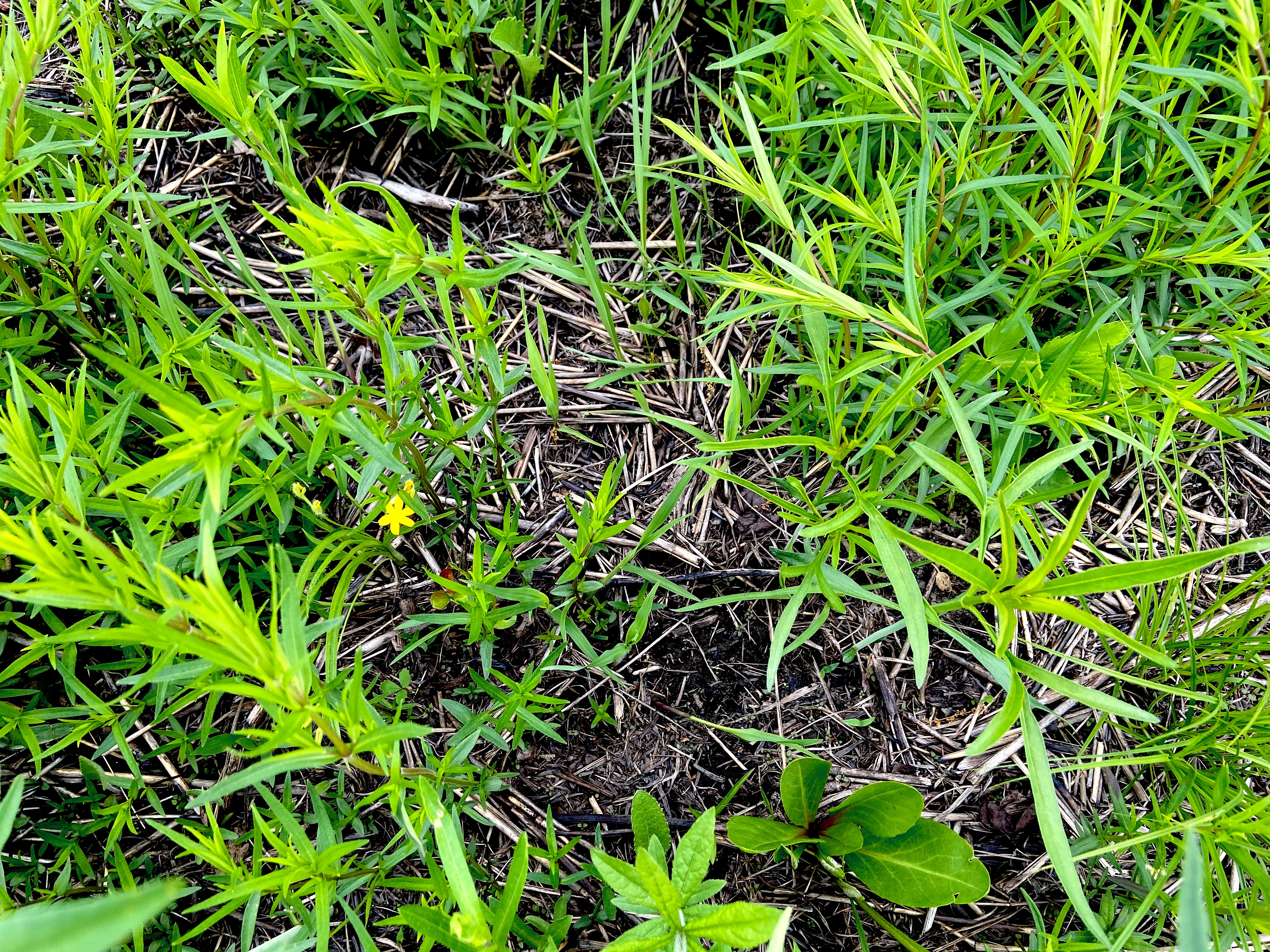
A transplant surviving in a Rank and Non-diverse plot is shown below:
 |
 |
| Here the young Hypoxis grows among high-conservative prairie violet, leadplant, and wild quinine along with mid-conservative rattlesnake master, compass plant, Culver’s root, hairy green sedge (Cx hirsutella), big bluestem, and others. |
New plants in diverse plot:
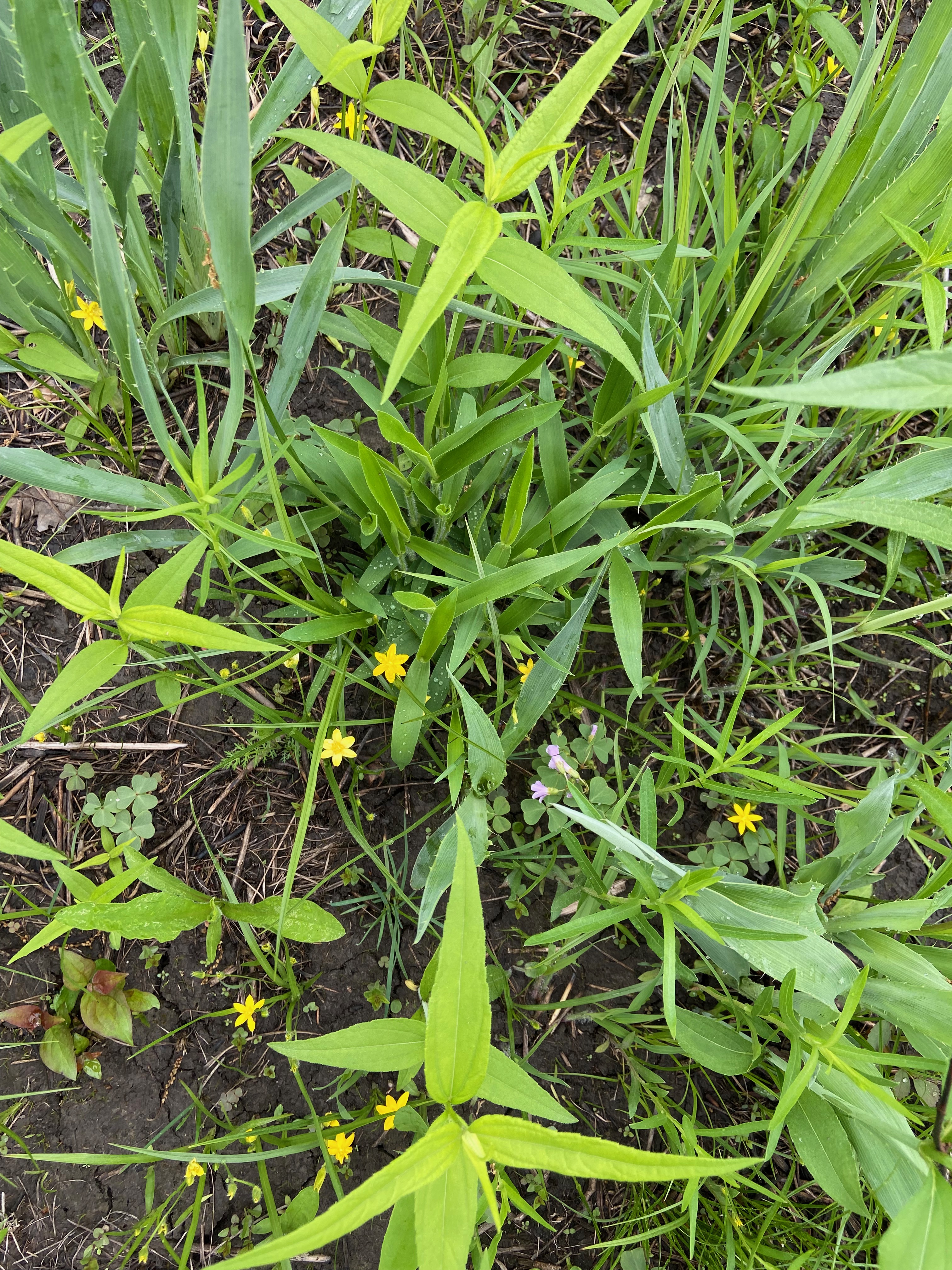
New plants, in a diverse area, broader view:

We were also interested in whether reproduction was vegetative or by seed, and if by seed, how far the seeds would be effectively spread. The table below shows distances of new plants from the original planted corms.
Table 3.
# | 2022 repro | Distances of new plants from original transplants |
1 | 0 | |
2 | 1 | 4” |
3 | 2 | 4’, 6’ |
4 | 1 | 8’ |
5 | 3 | 2’, 7’, 7’ |
6 | 6 | 2”, 8”, 2’, 3’, 5’, 10’ |
7 | 5 | 2’, 2’, 3’, 4’, 4’ |
8 | 5 | 4’, 5’, 10’, 10’, 11’ |
9 | 2 | 3’, 6’ |
10 | 0 | |
11 | 15 | 3”, 4,”, 5”, 10”, 1’, 1’, 2’, 2’, 2’, 3’, 3’, 4’, 5’, 5’, 6’, 9’, 10’ |
12 | 0 | |
13 | 1 | 6” |
14 | 4 | 7”, 9”, 10”, 4’ |
15 | 9 | 6”, 4’, 4’, 5’, 6’, 6’, 7’, 8’, 8’ |
Of 63 plants, only 11 are less than one foot from the originals. 52 were 2 to 10 feet away. (The seeds of this species clearly have ways to get around. It is known that the seeds of some plant species have special features that motivate ants to disperse them. No doubt others have other 'creative' ways.) These numbers suggest that the Hypoxis was reproducing by seed.
Plots 2 through 10 (above) are in prairie-like, very open savanna. Plots 13 through 15 are in shadier, but still open savanna. Corms planted in woodland areas have apparently not survived (perhaps because the woodland areas were not of high enough quality?). For notes about prairie, savanna, and woodland results, see Endnote 2. For cautions about the data, see Endnote 3.
Discussion and Possible Implications
Let’s stipulate that the biodiversity of the tallgrass region may be important. Much of the world’s food is grown here. Much good science talent is here. The genetic alleles most significant for heading off “crop pandemics” or to improve nutrition or to combat climate change may lie among the biota of our nature preserves.
The critical gene pools are not just of plants but also of bacteria, fungi, invertebrates, and much other biota. Despite the valiant efforts of preserve staff and volunteer stewards, even some of our best and most important nature preserves are losing plant species and other biota. Insufficient resources are focused on biodiversity, and even if many times the current amount can be obtained, the need will still vastly outstrip our funding and abilities. We need to become more expert and effective.
Many of our best biodiversity areas are too small. Species will not survive vicissitudes and adapt to climate and other changes unless their numbers and acreages increase. As Dr. Ron Panzer has shown for invertebrates, it is likely that for breadth of gene pools of the biota generally – that larger and more diverse preserves would contribute much that doesn’t survive in the smallest, highest-quality areas. For that, we need wise restoration or recovery efforts. Such work will be much facilitated as our expertise in ecosystem first-aid improves. Practitioners should keep records and write up results.
Endnotes
Endnote 1: Small
Ecosystem “restorations” are typically pathetically inferior to millenia-old original “remnants.” In comparison, the restorations tend to look “rank” and “wrong.” Prairie restorations usually lack most of the plant species of original prairies. If those species are planted by seed, they typically don’t survive. If planted by plugs, they often don't reproduce. For example, most prairie and savanna restorations have few if any of the little conservative species: small skullcap, prairie violet, Mead’s sedge, violet wood sorrel, and yellow star grass. Of course, many classic big species are also typically absent: prairie lily, heart-leaved Alexanders, prairie parsley, prairie white-fringed orchid, prairie gentian, prairie ladyslipper, etc. etc. It could be that many of the big species missing are those that reproduce best in the matrix that includes the small ones. (Of course, all the conservative species may benefit in various ways from all the others.) This study of Hypoxis looks into just one little species, but it suggests implications.
Endnote 2: Prairie, Savanna, and Woodland.
As we use the terms in this post, open savanna (or “Prairie” – as it was named in our former seed mixes) has trees nearby but no direct tree shade and includes all prairie plant species.
Mid savanna (as it is named in our seed mixes) has tree shade for one or a few hours a day and most prairie species, but also a substantial part of the vegetation consists of such shade-associated species as carrion flower, pale Indian plantain, meadow parsnip (Thaspium), veiny wild pea, and spreading dogbane. In such areas there tends to be a greater than normal preponderance of such prairie-and-savanna species as Culver’s root, big bluestem, wild quinine, and early goldenrod.
Closed savanna (as it is named in our seed mixes) has much dappled shade. Here the warm-season “prairie” grasses, though present, are less the principal fuel than are oak leaves and various sedges. Characteristic species may include rue anemone, wood pea (Lathyrus ochroleucus), broad-leaved panic grass, violet bush clover, and wild columbine.
Woodland is an important community that has not to date been well considered for its significance to biodiversity conservation. Characteristic species may include Carolina vetch, upright bindweed, Hypoxis, robin's plantain, wood rush, and wood pea. Another lesson of this experiment so far is that planted Hypoxis corms did not survive in our woodland plots. It’s likely that the problem was that these plots were in woodland restoration areas too new and rank and too dark. Hypoxis does survive in some remnant woodlands; indeed it is a major plant in some of the highest-quality woodlands.
Endnote 3: Caution about the data
It's good to separate what we know from what we reasonably suspect. For example, we do not know as a general principle that Hypoxis reproduces flowering new adult plants after eight growing seasons. We know that in this case this method of monitoring picked up the mature new plants in the ninth year, in these soils, among these associated species, under this burn regime, in this period of weather and climate, at this latitude and longitude. Results might be somewhat or highly different elsewhere. On the other hand, these results suggest promising approaches to restoration of this conservative plant and provide some preliminary data.
Endnote 4: Details about the transects and plots
These transects were set up by pacing off intervals and placing a flag in the ground at every ten meters. We measured by pacing instead of a meter tape because it's quicker. Some transects followed existing paths (also for convenience), but some crossed areas without paths, starting at one easy-to-locate tree and ending at another. At each flag, the crew would plant one corm about a half-meter to the right and one to the left. Actually, they'd kneel down at the flag and dig a hole for the corm a convenient bending distance (about 0.5 meters) to the right and the left.
We defined the plots in which we looked for reproduction as extending from a given planting point half way to the next. Thus the plots were ten meters long, centered on the planted corms. The plots extended about 4 meters to each side of the transect, as that was the distance over which we could see and count the blooming plants. Seeds may have travelled and succeeded farther away, but this was the area we had previously looked for reproduction and seen none.
We had not been confident that the transects would be easily re-located. But it did turn out to be easy, as we found no Hypoxis along these transects in 2019 and 2020 except for the lonely pair or single blooming plant at the ten meter intervals.
 |
| Here a lone Hypoxis has emerged among the pussytoes. Low-growing, conservative plant species (some of them hemi-parasites) will likely help maintain the diversity of the recovering prairie and savanna here. Such species include Hypoxis, bastard toadflax, Penn sedge, Mead’s sedge, small skullcap, and pussytoes. |
 | ||||||||||||||||||||||||||||||||||||||||||||||||||||||||||
| In this area, Hypoxis was apparently planted by seed four decades ago. It is now so thick that it could be said to comprise a part of the matrix that other conservative species are best seeded into. This density may be more than would be seen flowering in a very high-quality (and thus even more competitive) prairie turf. Transect Z Numbers of plants occurring at ten meter intervals - where planted
We were impressed by these hastily gathered results. But then we worried that this sample amounted to falsification of the overall result, as perhaps we were inspired to count there because we happened to see success as we walked down that trail. So we went to another transect that had also been burned that year. (Counts in unburned areas are lower. Fewer plants bloom in years without fire, and those that do may be obscured by duff.) This other nearby area produced the following very different results. |
Year | 2019 | 2025 |
| 2 | 2 |
| 1 | 0 |
| 1 | 1 |
| 1 | 1 |
| 1 | 1 |
| 1 | 0 |
Totals | 7 | 5 |
References
Many more details about this experiment are given in this earlier post.
An example of dense Hypoxis in high-quality white oak woodland can be found in a fine post by Dan Carter.
Acknowledgements
Hundreds of people deserve thanks for their contributions to this work.
Volunteer stewards and Cook County Forest Preserve staff have nurtured and restored Somme Prairie Grove since 1980. Sai Ramakrishna, Jeanne Dunning, and others planted the original 148 plus corms. Eriko Kojima helped find and monitor the transects in 2019 and 2022. Christos Economou, Adam Rux, Kathy Garness and Eriko Kojima contributed proofing and edits. Blame for the language in this post most goes to Stephen Packard, but in most cases the word "we" is used to reflect the contributions to the work and thinking by so many.

You have a unique dedication to following the establishment of conservative species.
ReplyDeleteThere are two places with yellow star grass that come to my mind first. One is a limy meadow with mounds of Carex crawei. The yellow star grass grew on the mounds and ridges that were just above the water table after a rain. The second place is the summit on a slope in a woodland over Potsdam sandstone. These habitats are about as opposite as is possible. The similarity is the lack of competition.
Given time, I am sure the yellow star grass at Somme Prairie Grove will fill in densely. It has grown well in my garden. Growing it is not the problem. It is that the increase is slow because it takes several years to mature from seed.
This plant seems to thrive in sedge meadows and other "not dry" and "not well drained" areas with the violet wood sorrel, dense blazing star, ragged&grassy orchids, seedbox, lobellia sp, skullcaps, pussytoes, blue eyed grass, steeple bush, blue vervain, St. John Wort sp, etc. I'm not certain I have seen even one plant in an area not squishy. Have you guys done recovery efforts in your heavily shaded wet areas to see what sort of surprises come up? Maybe plant some in areas it is a little wetter area to establish a big populations for later collection and redistribution. I'm not certain how valid my observations (mostly areas that were choked out with glossy buckthorn) are but seems to take a year with sunlight before they start blooming. There is far more of this in my area than the CDF reports from mid 2000s indicated and possibly these areas were heavily shaded at the time the reports were put together and there were tons of dormant korms in the ground. My only discussions with plant people and botanists for this goes like "wow really cool so many of these here" (they humor me a lot).
ReplyDeleteIt's good and important that many people are learning plants and developing local expertise. As we do it's best to be aware that habitats for some species can vary dramatically. Yellow star grass is most often found in high-quality natural areas. But the types of such areas are all over the map. Wilhelm and Rericha ("Flora of the Chicago Region") record habitats for yellow star grass that range from wet prairie to dry white oak savanna. It's inspiring to witness how varied the habitats of this conservative plant can be.
ReplyDelete